Monet in Giverny: his life, his family, his illness and his legacy
What was Claude Monet’s real first name?
Oscar-Claude. His family called him Oscar, and he signed his early caricatures, drawn as a teenager in Le Havre, “O. Monet”. The name Claude became standard as his painting career took off. On his grave and in catalogues, it’s Claude Monet; in his mother’s letters, it was Oscar.
What was Monet’s nationality?
French. He was born in Paris, on rue Laffitte, on 14 November 1840, and grew up in Le Havre, where his father moved for business. He lived in Argenteuil, Vétheuil and then Giverny, in the Eure, for forty-three years. I’m often asked if he was Norman: he became one, but wasn’t born there.
Who was Monet’s wife?
He had two. Camille Doncieux, whom he married in 1870, was the model for *The Woman in the Green Dress* and *Women in the Garden*; she died in 1879, aged 32. Alice Hoschedé, the widow of Ernest Hoschedé, a former collector who went bankrupt, was already living with Monet and his children when they arrived in Giverny; they married in 1892, after Ernest’s death. Alice died in 1911. Her apartment can be visited in the house.
How many children did Monet have?
Two sons, both with Camille: Jean, born in 1867, and Michel, born in 1878. Alice brought six Hoschedé children, including Blanche, Suzanne, Germaine and Jean-Pierre, who were raised in Giverny. The house was home to a blended family of ten. Jean married Blanche Hoschedé, his stepsister by marriage, who also painted; her bedroom was recreated in 2013.
What illness did Monet have?
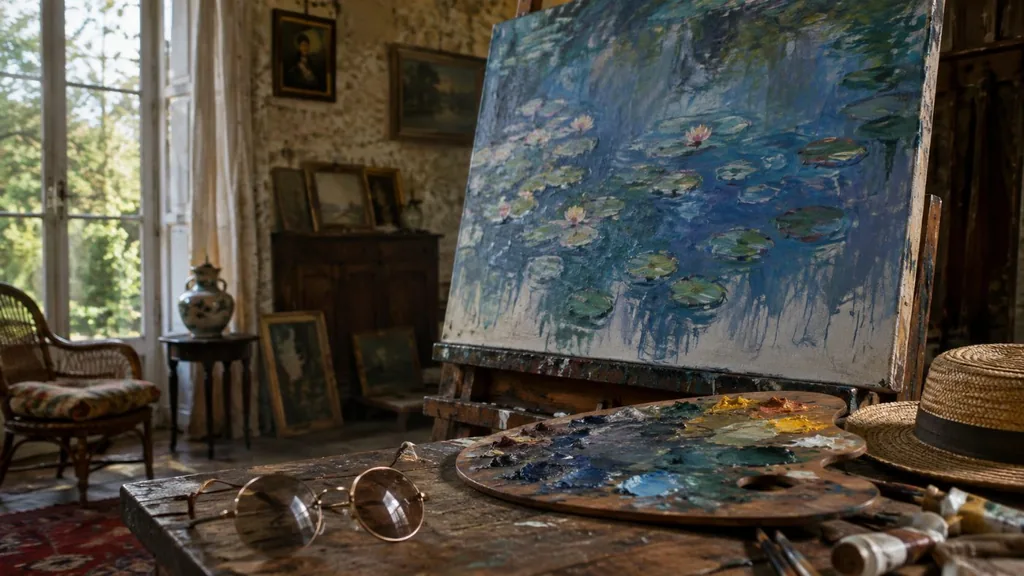
Cataracts in both eyes, diagnosed in 1912. He saw colours turn yellow-brown and painted *Water Lilies* in increasingly red and orange hues. He long refused surgery, then had three operations on his right eye in 1923; he gave up on the left eye and wore tinted glasses. When a guide shows you the late canvases, this is what they’re talking about.
Who was Monet’s best friend?
Georges Clemenceau. The Prime Minister often visited Giverny, urged Monet to finish the large *Water Lilies* Decorations, and secured their installation at the Musée de l’Orangerie, which opened in 1927, five months after the painter’s death. Other close friends included Renoir, Bazille (killed in 1870), Caillebotte, Mirbeau, Sisley and Pissarro.
What did Monet die of, and where is he buried?
Lung cancer, on 5 December 1926, in his house in Giverny, at the age of 86. He is buried in the cemetery of Sainte-Radegonde church, in the Hoschedé-Monet family vault, a ten-minute walk from the house. The ceremony was civil, with no mass; the coffin was carried by neighbours. Clemenceau tore off the black cloth draped over the coffin: “No black for Monet.” Several excursions from Paris stop at the grave.
Who inherited from Monet?
Michel Monet, the surviving son (Jean had died in 1914). Blanche Hoschedé-Monet, his daughter-in-law and stepdaughter, whom Clemenceau called “the blue angel”, lived in the house and maintained it until her death in 1947. After her, the house fell into disrepair and the garden became overgrown.
Who was Michel Monet?
The second son, born in 1878, who had no children. He died in a car accident in 1966 and bequeathed the property and the paintings he owned to the Académie des Beaux-Arts. The Académie entrusted the paintings to the Musée Marmottan, now the Musée Marmottan Monet, and the house to the Fondation Monet Giverny.
Does Monet have a great-grandson?
Not by blood: Jean and Michel both died childless. The person often referred to as “Monet’s great-grandson,” Philippe Piguet, an art historian and exhibition curator, is descended from Alice Hoschedé. He is therefore the great-grandson of Monet’s second wife, from the Hoschedé family, and not of Monet himself.
When was the house restored and opened to the public?
Restoration began in 1977, led by Gérald Van der Kemp, former curator of Versailles, and largely funded by American patrons through the Versailles Foundation. The water garden, the bridge, the flowerbeds of the Clos Normand, and the house were reconstructed based on photographs and paintings. The site opened to the public in 1980; Monet’s bedroom was restored in 2013. The estate is open from April 1st to November 1st—see opening dates. For the garden’s timeline itself—arrival in 1883, purchase on November 17, 1890, water garden starting in 1893 on land bought across the railway tracks, first water lilies planted in 1902, pond expanded around 1901–1910—read the complete guide.
These are exactly the kinds of questions guides address on-site; several guided tour reviews say, “We learned so much about Monet and his family.” If you’re more interested in his biography than the flowers, hire a guide.
Frequently asked questions
Why did Monet settle in Giverny?
He rented the house called “Le Pressoir” on April 29, 1883, while searching for a country home for his blended family, and bought it on November 17, 1890. The water garden followed in 1893.
How many *Water Lilies* paintings did Monet create?
Around 250 canvases between 1897 and 1926. The eight large panels are at the Orangerie—see where Monet’s water lilies are located.
Can you visit Monet’s grave?
Yes, in the cemetery of Sainte-Radegonde church, about a ten-minute walk from the house, with free access. Several tours stop there.
Is this the house where Monet actually lived?
Yes, the very same house, restored starting in 1977 and opened in 1980, complete with its original furnishings, colors, and 243 Japanese prints. The complete guide describes each room.
Where can you see Monet’s paintings after visiting Giverny?
In Paris: the Orangerie for the large *Decorations*, the Marmottan Monet for Michel Monet’s bequest, and the Musée d’Orsay for his Impressionist works. See Is Giverny worth it? for combining both experiences.